On January 12, Aging and Disease, one of the world's most influential medical journals in aging research (JCR Q1, IF 7.50), published online the paper "DNA demethylation of promoter region facilitates Atoh-1-induced interleukin-19 expression activation in bone marrow monocytes of old mice." The project was led by Professor Qinghua Zhao's team at Shanghai General Hospital, with Professor Yongming Xi's team at the Affiliated Hospital of Qingdao University participating. Yanan Chen, a graduate student in orthopedics, was the first author.
Aging is an extremely complex biological process. Low-grade inflammation is a hallmark of aging and an important driver of age-related disease. Immune dysfunction mediated by inflammation plays an important role in the development of osteoporosis. IL-19 is a member of the IL-10 cytokine family. Current views regard IL-19 as a key cytokine beyond the classic Th1/Th2 balance, but its pro-inflammatory or anti-inflammatory role remains controversial and may differ between diseases and cell types. No previous report had clarified the relationship between IL-19 and osteoporosis.
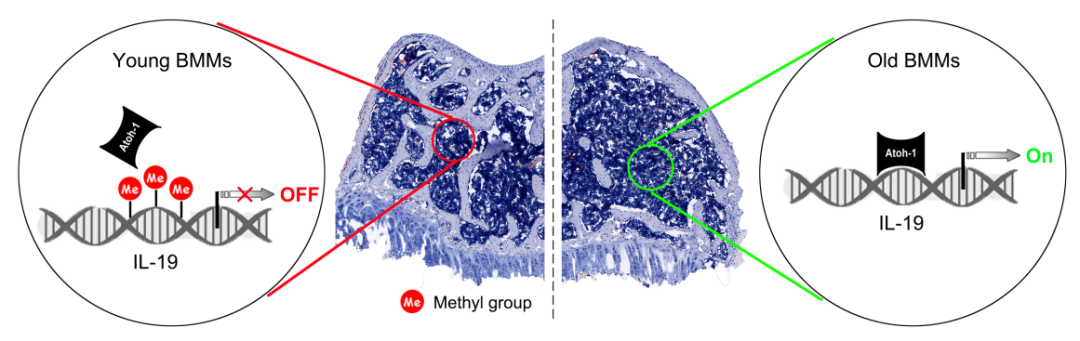
The study confirmed that increased IL-19 expression and secretion promote the progression of age-related bone loss. It also revealed that the upstream regulatory mechanism is mainly related to the methylation state of the IL-19 gene promoter, which affects the ability of the transcription factor Atoh1 to bind to the promoter. This specific mechanism involves reduced expression of DNA methyltransferase 1 (Dnmt1) and reduced binding of Dnmt1 to the IL-19 promoter. The findings improve understanding of DNA-methylation mechanisms, and IL-19 intervention may become a new approach for the treatment and prevention of bone-metabolism diseases.
A second paper from the team was published in November 2023 in Bone & Joint Research (JCR Q1, IF 4.73), titled "Interleukin-19 promotes bone resorption by suppressing osteoprotegerin expression in BMSCs in a lipopolysaccharide-induced bone loss mouse model." Zhi-Cheng Dai, a graduate student in orthopedics, was the first author.
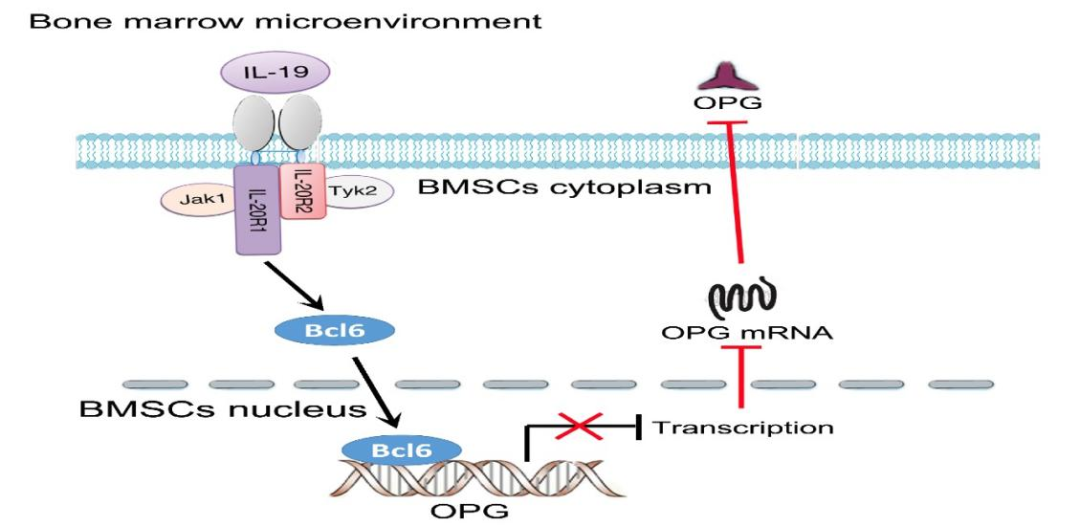
The study systematically revealed the mechanism of IL-19 in an LPS-induced bone-loss model. Compared with controls, mice with LPS-induced inflammatory bone loss had markedly higher IL-19 levels in serum and bone marrow. Systemic IL-19 knockout counteracted LPS-induced inflammatory bone loss. The research team found that IL-19 acts through Bcl6 to suppress osteoprotegerin (OPG) expression in bone-marrow mesenchymal stem cells (BMSCs).
Because most cytokines cause inflammation, many reports have focused on pro-inflammatory cytokines, which have become modern drug targets. In comparison, fewer studies have examined anti-inflammatory cytokines. The team's two recent papers consistently indicate that IL-19 may play an important role in influencing bone mass. IL-19 may become a new treatment and prevention target for bone-metabolism diseases.
Osteoporosis is one of the most common systemic bone diseases closely associated with aging. Over the past decade, Professor Zhao's team has focused on regulatory mechanisms in age-related bone-metabolism diseases. The team was among the first internationally to study SIRT2-regulated liver-bone organ communication in aging hepatocytes. Over the past five years, it has published multiple high-level papers in international and Chinese journals including Nature Metabolism, Spine, FEBS Journal, Cellular Signalling, and the Chinese Medical Journal, and has delivered more than ten presentations at international and domestic conferences.